
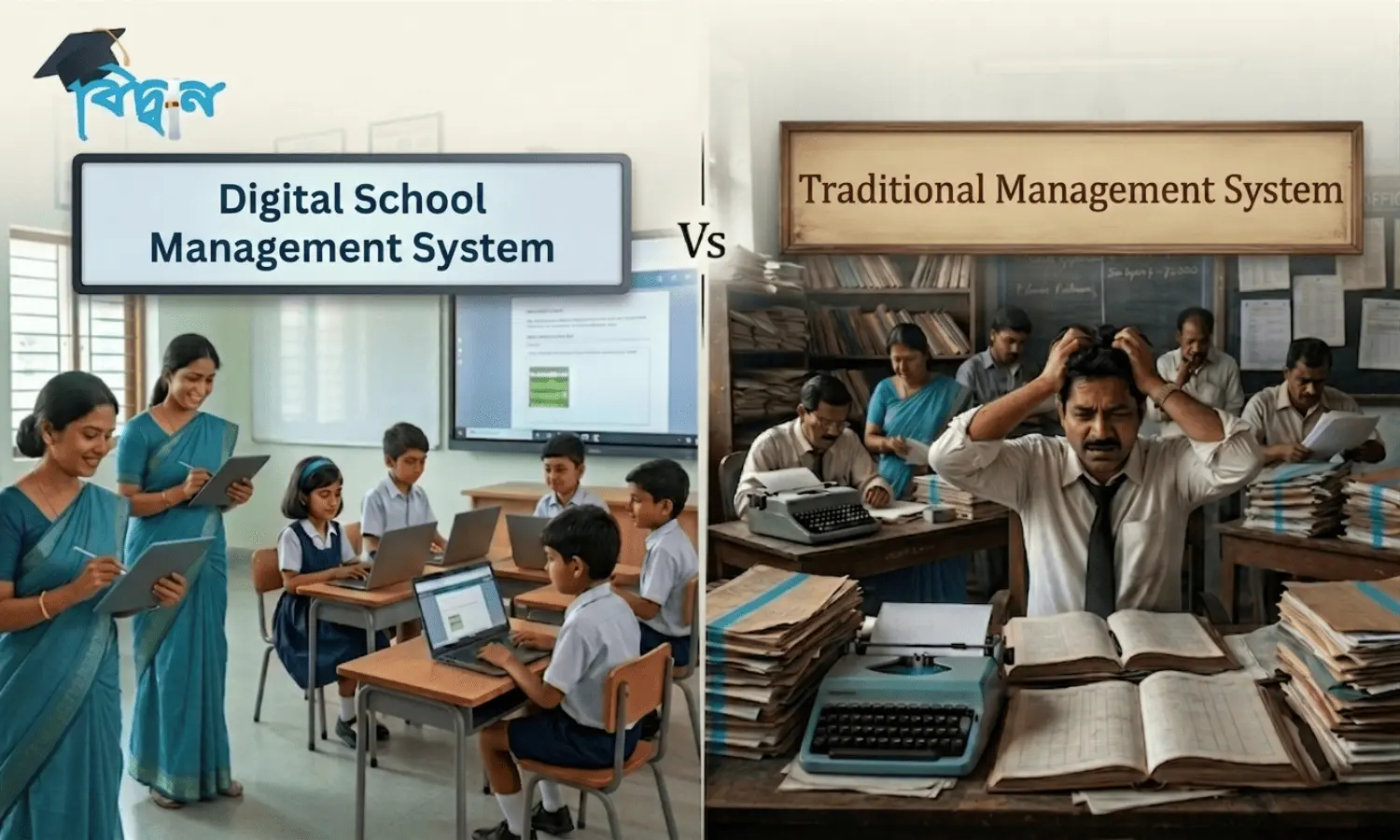
A school management system helps schools organize academic and administrative work. Many institutions in Bangladesh still depend on paper registers and spreadsheets. These traditional methods can slow down daily operations and increase the risk of errors.
Cloud-based school management software stores student records, attendance, exam results, and financial data in one place. Teachers and administrators can access information quickly and update records in real time. Because of these advantages, many institutions in Bangladesh are moving toward digital school management software to improve efficiency and transparency.
What is a School Management System?
School management system is a digital platform used by educational institutions to manage academic and administrative activities in schools, colleges, and madrasahs. The system helps institutions organize information and reduce manual work.
Traditional School Management System vs School ERP Software
Schools traditionally relied on paper files, registers, and spreadsheets to manage operations. While this method worked for many years, it often caused delays and data errors.
A school ERP software system offers a more efficient approach by automating daily tasks and storing information digitally.
| Feature | Traditional System | School ERP Software |
| Data Storage | Paper files or spreadsheets | Centralized cloud database |
| Attendance Tracking | Manual register entry | Automated digital attendance |
| Result Management | Manual result preparation | Automated result processing |
| Fee Collection | Manual ledger tracking | Digital fee management system |
| Parent Communication | Notices or phone calls | Instant notifications |
| Reporting | Time-consuming manual reports | Real-time analytics dashboard |
With an ERP system, schools can manage information faster and with fewer errors.
Challenges of the Traditional School Management System
Many educational institutions still depend on manual processes. These methods create several operational challenges.
- Paper-Based Records: Student information is stored in files and registers. Over time, managing these records becomes difficult.
- Manual Attendance Tracking: Teachers record attendance on paper. Finding past attendance data later can take time.
- Result Preparation Delays: Exam results are often prepared manually. This process may cause calculation mistakes and delays.
- Fee Management Errors: Tracking payments, dues, and receipts manually can lead to confusion in financial records.
- Lack of Centralized Data: Information is stored in different places. Administrators cannot easily access all records from one system.
These issues slow down school operations and increase administrative workload.
How a Digital School Management System Solves These Problems
A digital school management system simplifies many daily tasks for schools and colleges.
- Automated Attendance Tracking: Teachers can record attendance digitally through a web or mobile system. Schools can also generate attendance reports instantly.
- Digital Result Management: Marks can be entered into the system, and results are calculated automatically. This reduces errors and saves time.
- Centralized Student Database: All student information is stored in one secure platform. Administrators can access data quickly when needed.
- Automated Fee Tracking: The system records payments and dues automatically. Financial reports become easier to manage.
- Real-Time Communication with Guardians: Schools can send updates about attendance, notices, or results directly to parents.
These features make academic and administrative management more organized.
(Read our complete 2026 guide on adopting a digital attendance system for schools in Bangladesh).
Best School Management System in Bangladesh: Bidyaan
Many institutions in Bangladesh are now adopting digital management systems. One example is Bidyaan School Management Software, a cloud-based platform designed for schools, colleges, and madrasahs.
The system provides modules for student management, attendance tracking, exam processing, and fee management. Because the platform operates on the cloud, administrators can access information from different locations. Institutions also benefit from technical support and training, which helps schools implement the system smoothly.
How Schools Can Transition from Traditional Systems to ERP
Evaluate Current Administrative Challenges: Identify the areas where manual work causes delays or errors.
Identify Required Modules: Determine which features are most important, such as attendance, exam management, or fee tracking.
Choose a Cloud-Based School ERP: Select a system that allows secure access from multiple devices.
Train Teachers and Administrative Staff: Provide basic training so that staff can use the platform confidently.
Start with Core Modules: Begin with essential modules like student records and attendance, then expand gradually.
Frequently Asked Questions
What is a school management system?
A school management system is a digital platform that helps educational institutions manage academic and administrative tasks. It stores student records, attendance data, exam results, and fee information in one system. This helps schools organize information and reduce manual work.
Why are schools moving to ERP software?
Many schools adopt ERP systems to reduce paperwork and improve efficiency. Digital platforms help institutions manage student records, communication, and financial data more easily. They also allow administrators to access reports quickly.
Is school ERP suitable for small schools?
Yes, ERP systems can work for both small and large institutions. Many platforms allow schools to start with basic modules and expand later as their needs grow.
Can ERP manage student attendance and results?
Most school ERP systems include attendance and exam management modules. Teachers can record attendance digitally and enter exam marks, while the system generates reports automatically.
How secure is cloud-based school ERP software?
Cloud-based systems store data on secure servers with access control. Authorized users such as teachers and administrators can log in safely and manage information without risking data loss.
Is ERP software useful for madrasahs?
Yes, madrasahs can use ERP software to manage student records, class schedules, exam results, and financial data. The system helps keep academic and administrative work organized.
Upgrade Your Institution with the Best School Management System
Managing school operations manually can slow down daily work. The best school management system helps institutions organize all academic work from one platform.
If your school is planning to adopt a school ERP solution, contact us for a demo to understand how the platform works in real school environments.


Leave a Comment